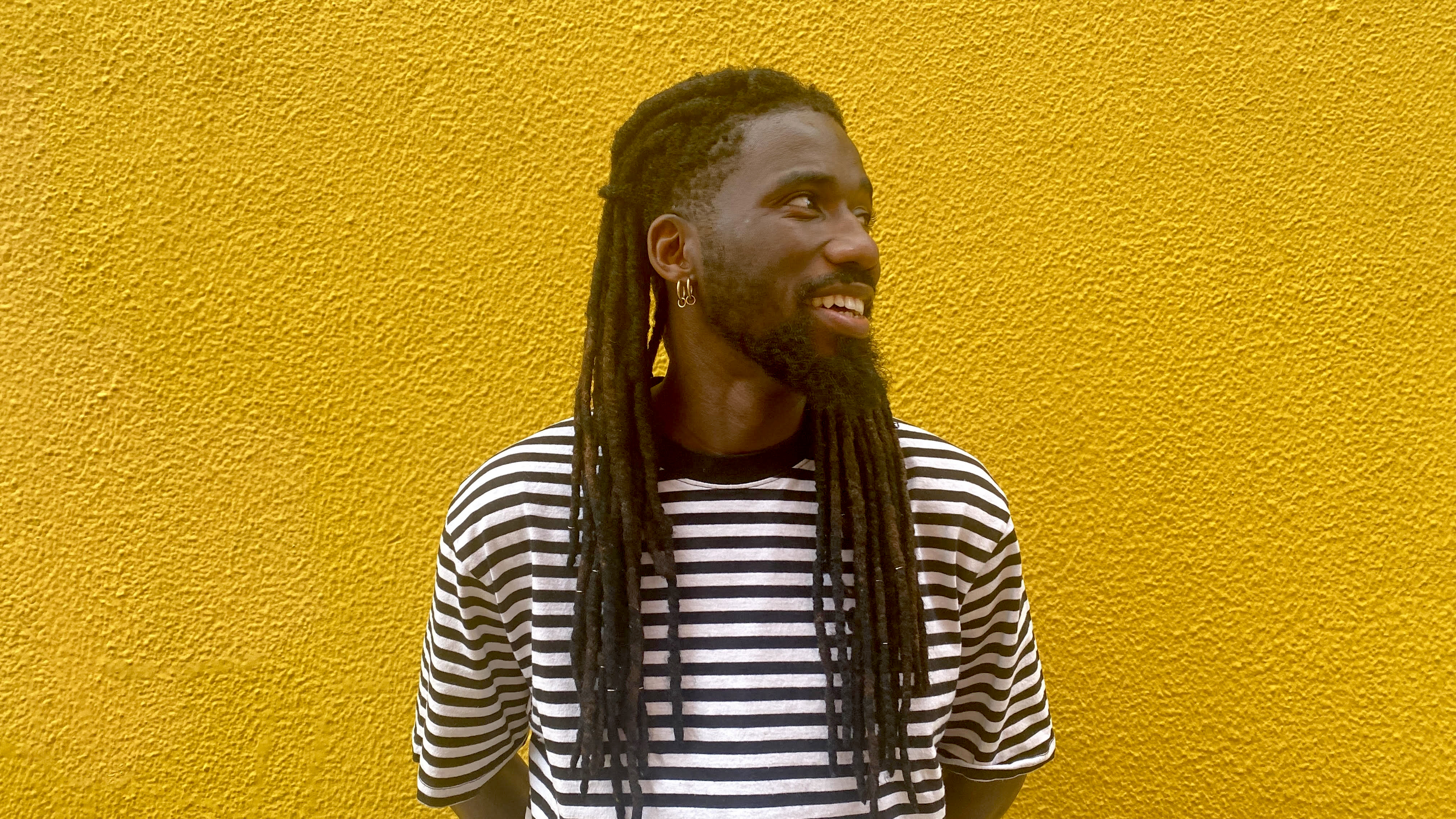


INTERVIEW WITH CARLOS STOCK: FROM CHILDHOOD IN NAMIBE TO URBAN ART IN BAIRRO DA TORRE, CASCAIS.
Text: Entrevista realizada por Otávio Raposo, texto de Pedro Varela.
Photos/video: Vários
Carlos Stock, artistically known as Kiã, was born in Portugal in 1993. The son of an Angolan mother and a São Toméan father, he spent his childhood in Angola, between Namibe and Luanda, returning to Portugal at age 11. He grew up and lives in the Torre neighbourhood in Cascais, where he developed a passion for drawing and painting.
Currently, he develops social intervention projects alongside his artistic practice, exploring different techniques. Leader of the youth association Somos Torre, organizer of the Infinito Festival (an annual urban art event), and worker on a project of the Escolhas Program, Carlos Stock has been forging his path in the Portuguese art scene, with increasing national recognition and participation in exhibitions at MU.SA and MAAT.
In this interview, he explains the importance of the territory where he grew up to his artistic creations.
E: Tell us a little about your past.
Carlos Stock: I was born in Portugal in 1993 and, at the age of one, I went to Angola with my mother. I wasn't supposed to be born in Portugal; I should have been born in Angola. I lived in Namibe and also in Luanda. At 11, I returned to Portugal and lived with my grandmother. I'm very happy to have experienced both sides. In Angola, I experienced incredible things, and here my adolescence was good too. I've kept in touch with Angola, but unfortunately, I've never been able to return to Namibe and remember certain things I experienced there. Namibe is a city near the desert, and I remember that, as a child, I often went there. My father often took me there. And then, you have an incredible natural phenomenon, which is the desert on one side and the Atlantic on the other. That's visually very different. Then, at 8 years old, we moved to Luanda, and I lived there for 3 years. In Luanda, things were a little different. I adapted, but I also have good memories of Luanda. And then, at age 11, I came to Portugal.
E: And what was it like growing up in the Torre neighbourhood in Cascais?
Carlos Stock: It was good! I think it was a quality growing, especially during adolescence, which is a more delicate phase. Over time, I became aware of the difficulties of the area, but I never lacked the basics. I always had good pillars in my family context, something I consider important.
E: Tell us how you became connected to art?
Carlos Stock: In my family, no one is connected to the art world. I remember having a great liking and aptitude for drawing. And I was very dedicated and persistent. It might not have been going well, but I was always doing it. If you're doing the same exercise every day, you'll eventually gain skill. I think that's what happened. There were times when I stopped: I went 5 years without holding a pencil to draw. But then I would come back and already have that ease. At school, I was very interested in the arts, also because other boys already had that inclination. So, I developed my skills: in high school, I studied art, then went on to a vocational course in graphic design. During the pandemic, at home, I got back into the habit of drawing. I kept working, I kept creating, I kept trying… The brain has memory, even if you don’t draw for a long time. I already had the habit, so it was easy to get back into it. I realised, then, that I could try an artistic career. I was already part of the group that organised the Infinito Festival here in the neighbourhood; some artists were working here in Torre. I concluded that it could be an alternative for me, and I started painting. I started on paper, then painted a door, another door, and a wooden sign, until finally I painted my first wall.
E: How did the Infinito Festival influence your process of entering the art world?
Carlos Stock: Seeing the artists working at the Infinito Festival, I realised what tools were needed to make the transition from painting on paper to painting on a wall or other surface. I was already talking to the people from the Somos Torre Association and told them they had to find me a wall to do my first mural. And they replied: "You still have to practice a little more." That was the process. So, I started drawing and painting doors, wooden boards, and other materials. Then, I started painting on walls, carrying out my first intervention in this style in 2020. During the pandemic, the Cascais City Council launched the Talent Promotion Grants, which I also participated in. That's when the hand drawing was born.
E: Tell us the story of how the leftover materials from the Infinito Festival became important to you.
Carlos Stock: I was at a more initial stage. Many times, I didn't have materials, cans or brushes, and the Infinito Festival ended up being important because the artists often left their materials behind. They painted, and there were plenty of leftover spray cans and buckets of paint, and I saved them. And whenever I needed to paint something, I used those materials. Sometimes you didn't have the colours you liked, right? They weren't colours I loved, but it was what I had, so I ended up adapting and painting, making things. And the first works, the first attempts, were made with the materials from the artists at the Infinito Festival. Doors were things I found leaning in the trash. I picked them up and took them with me. Because I didn't have walls, right? You had to ask for permission. You have to go to the buildings and ask each person for permission. If it's a building belonging to the City Hall, you have to send an email to the City Hall, and it was very difficult to get those permissions, so the solution was to paint things I found on the street: doors, wooden boards, televisions, or refrigerators.
E: And how did you go from the Torre neighbourhood to exhibitions and galleries?
Carlos Stock: There was a period when I no longer had walls to paint on, so I started making my first paintings. The first exhibition I participated in was in 2021 with the Coletivo Corrente de Ar. It was an open call; you had to submit your work, explain the concept, and everything. And I submitted it. And it was the first time; I had never participated in an event of that kind. My work was approved, and I was super happy. We went to the gallery, and it was an exhibition of people who weren't very well-known either, but who wanted to create something. On the opening day, there were so many people; the line of people waiting stretched around two corners. I was very happy. Then I went back to the neighbourhood and started painting household appliances. It was out of necessity, wanting to paint and not having walls. We have a lot of scrap yards in the neighbourhood. The scrapyard habit is present in any neighbourhood. People take household appliances, remove the copper from inside refrigerators, televisions, or radios, and then sell it. Then the carcass was left there abandoned. So, I started using these tools and painting. And I painted a refrigerator, a yellow refrigerator. This refrigerator was also interesting because the kids from the community participated; they made an abstract scene there, and I drew on top of it. I took some photos, put them online, and people liked them. Meanwhile, since I was already participating in these exhibitions, the opportunity arose to be part of one at MU.SA (Sintra Museum of Arts), aimed at artists who lived in peripheral areas. They called me: “Look, we have this exhibition here at MU.SA, if you want to participate, you could bring a piece you like to introduce it to people.” And since I already had the refrigerator, I took it to the exhibition. It was a different piece. I am very grateful to the people who were involved in the organisation, as it was an incredible opportunity that gave me greater motivation to develop other types of things. Perhaps, instead of a refrigerator, I could move on to another type of equipment. This exhibition was the trigger for another exhibition I participated in: Interferences at MAAT (Museum of Art, Architecture and Technology), in Lisbon. MAAT was incredible. Everyone knows MAAT. And for us it was also interesting, even because of the type of exhibition it was; it wasn't just about art, but it was also quite informative and had a lot to do with artists from the periphery.
E: And what piece did you bring to the group exhibition "Interferences" at MAAT?
Carlos Stock: My piece was an old motorcycle that belonged to a fisherman from the neighbourhood. We always saw him with that motorcycle, which later broke down and was abandoned. And I kept looking at it, and I thought: "I've already painted a refrigerator; maybe this motorcycle could be the next piece." And it made sense to me because our neighbourhood was a fishermen's neighbourhood; it was something that greatly represented Torre. Anyone who comes to our neighbourhood will see that the street names are linked to the sea, because it's a fishermen’s neighbourhood. It was funny because I, an African from a generation that came after the fishermen, was portraying a reality before mine: the life of fishing. The piece is called "Kota Gil" and, in a way, is a portrait of him. The motorcycle was a tool to help the man with fishing, but then it broke down. Almost as if we wanted to give it new life, the piece functions as a tribute to its former owner. I went to Mr Gil, told him what I wanted to do, and he was happy. I asked if I could photograph him, and I did. He told me a little about his story: his stories with his motorcycle. Then I started developing the piece. The motorcycle was at MAAT, and it had several planes of the man's face. It had his face, but from his face came several fish that circled the motorcycle. I come from urban art, which is art done on the street, but I was taking a piece into a gallery. So, I was trying to preserve a bit of that street identity. Since that motorcycle was found abandoned on the street, the piece was placed on structures inside MAAT, as if it were truly abandoned. Even going inside MAAT, I tried, in some way, to preserve that street atmosphere.
E: What do you try to show with your works?
Carlos Stock: You have the techniques, the way you paint, but then you need to start thinking about the kind of concepts you will develop from the techniques you have. Initially, because I painted a lot on the street, I never saw a specific theme or critical thought I could bring to the pieces. I painted on the street and painted a lot of what people asked me to. Later, when I started painting more canvases, I naturally tended to include more African imagery. I tried to portray many of the ethnic groups that live in Angola and other African countries, but initially, they were just tests. It was a way of understanding, while painting, how the images would turn out, how they would look visually, whether I liked them or not… and that was it. My idea and what I want for the future is to develop my own identity in my representations. This largely involves connecting the more ancestral scene in Angola with the processes of globalisation felt more strongly here in Portugal.
Link to access Carlos Stock's (Kiã) page: https://www.instagram.com/kiam______/
Photo Credits:
Image 1 – Carlos Stock, photograph by Pedro Varela.
Image 2 – Visit to the Torre neighbourhood with Robz, featuring a painting by Kiã, photograph by Beatriz Lacerda.
Image 3 – Artwork by Kiã, photograph by Carlos Stock.
Image 4 – "Kota Gil" at Interferências.
Image 5 – Graffiti by Gonçalo Mar and Kiã in the Torre neighbourhood, photograph by Pedro Varela.
Image 6 – "Welcome to ZUS" by Kiã, photograph by Carlos Stock.